A 12d Synergy alternative built for the asset owner’s record.
For the owners and document controllers who hold the record long after the design office moves on. Put every DWG, DGN, and RVT under revision control, search the text printed inside scanned sheets, and open any drawing in a browser tab, with no Windows client to deploy and no server of your own in the way.
10M+ documents under management · Hosted in Australia and the US · SAML · Full audit trail
12d Synergy is strong where civil design data is made.
It grew out of 12d Solutions, the Australian company behind 12d Model, and the heritage shows. Folder-based engineering datasets stay whole, DWG Xrefs and 12d projects keep their dependencies, project email files itself to the job from Outlook, and remote offices pull only the bytes that changed. A civil design office running 12d Model, Civil 3D, and survey data all day should keep it.
The claim here is narrow. It is about the record after handover, and about who can still reach that record in year fifteen of a thirty-year asset.
Read how an owner-side common data environment works- Civil design data from 12d Model, held as a managed dataset so a folder-based project keeps its dependencies.
- Survey and modelling folders from LISCAD, TUFLOW, XP SWMM, and SPACEGASS, protected as a single working set.
- CAD authoring at the desk, through plugins for 12d Model, Civil 3D, BricsCAD, MicroStation, and OpenRoads.
- Multi-office worksharing over a WAN, where a File Replication Server caches files and sends only the changed bytes.
Where an owner hits the edge of a design-office platform.
Each point below is drawn from 12d Synergy’s own published system requirements, help documentation, and pricing tiers, so your IT department can check every one of them. Together they describe what an owner carries to keep the drawing record available to the whole organisation.
12d Synergy and Lunr, capability by capability.
A factual read of what each system does across the life of a drawing. The two are not rivals for every row. 12d Synergy holds the advantage while the civil design is being produced, and Lunr holds it once the drawing is issued and the rest of the organisation needs to read, search, and control the record.
| Capability | On 12d Synergy | On Lunr |
|---|---|---|
| Managing live 12d Model and civil design data | Yes, managed datasets built around it | Not a design data manager; issued drawings arrive by connector, upload, or transmittal |
| Folder-based datasets such as TUFLOW, XP SWMM, and SPACEGASS | Held as one protected working set with dependencies | Held as controlled documents, without folder dependency management |
| The primary way a person reaches the record | A Windows desktop client, with a stripped-down web and mobile app | The browser, on any operating system |
| Workstation requirements to read a drawing | Windows 10 or later, with .NET Framework 4.8 | A browser, with nothing installed |
| Servers needed to run the record | Windows Server and SQL Server when self-hosted | None, the record runs in the browser |
| What a person is allowed to do | Set by the Collaborator Pro, Information Management, or Advanced Data Management tier | Every capability standard, for everyone you grant access |
| Multi-office worksharing over a WAN | File Replication Server, sending byte-level deltas | One hosted record, reached over the internet from anywhere |
| Opening a DWG, DGN, or RVT without a CAD licence | IFC model viewer in the web app, CAD plugins at the desk | Rift for drawings, Foundry for models, Nimbus for point clouds |
| Finding a note printed inside a scanned sheet | Search across jobs, files, and attributes | XRAY reads every sheet with OCR, and Deep XRAY re-scans a dense drawing tile by tile |
| A controlled record for the operating life of the asset | Delivery focused, with handover into downstream systems | The owner's register, held for the decades the asset runs |
| Where the data sits | Vendor cloud, your own server, or your own cloud | Hosted in Australia or the US, in the region you require |
12d Synergy rows describe the platform as published by 12d Synergy in its product pages, pricing tiers, and system requirements. Where a capability is unpublished, the row states what Lunr does rather than guessing.
Open a DWG, DGN, or RVT in a browser tab, on any machine.
With 12d Synergy, full access means the Windows client, and the web and mobile apps are documented as a stripped-down version of it. In Lunr the Rift viewer renders DWG, DGN, and PDF at full fidelity, with layers, measurement, and markup, in the browser. Models open in Foundry, point clouds in Nimbus, on a laptop or from the field.
- View DWG, DGN, RVT, and PDF in the browser, with no CAD licence and nothing to install.
- Toggle layers, measure to the drawing's own scale, and mark up with a revision cloud.
- Work on macOS, Windows, a tablet, or a phone, without a supported-client list to police.
- Give operations, facilities, and contractors access without a workstation rollout.
browser viewers · layers · measurement · markup · no client install
Try the viewers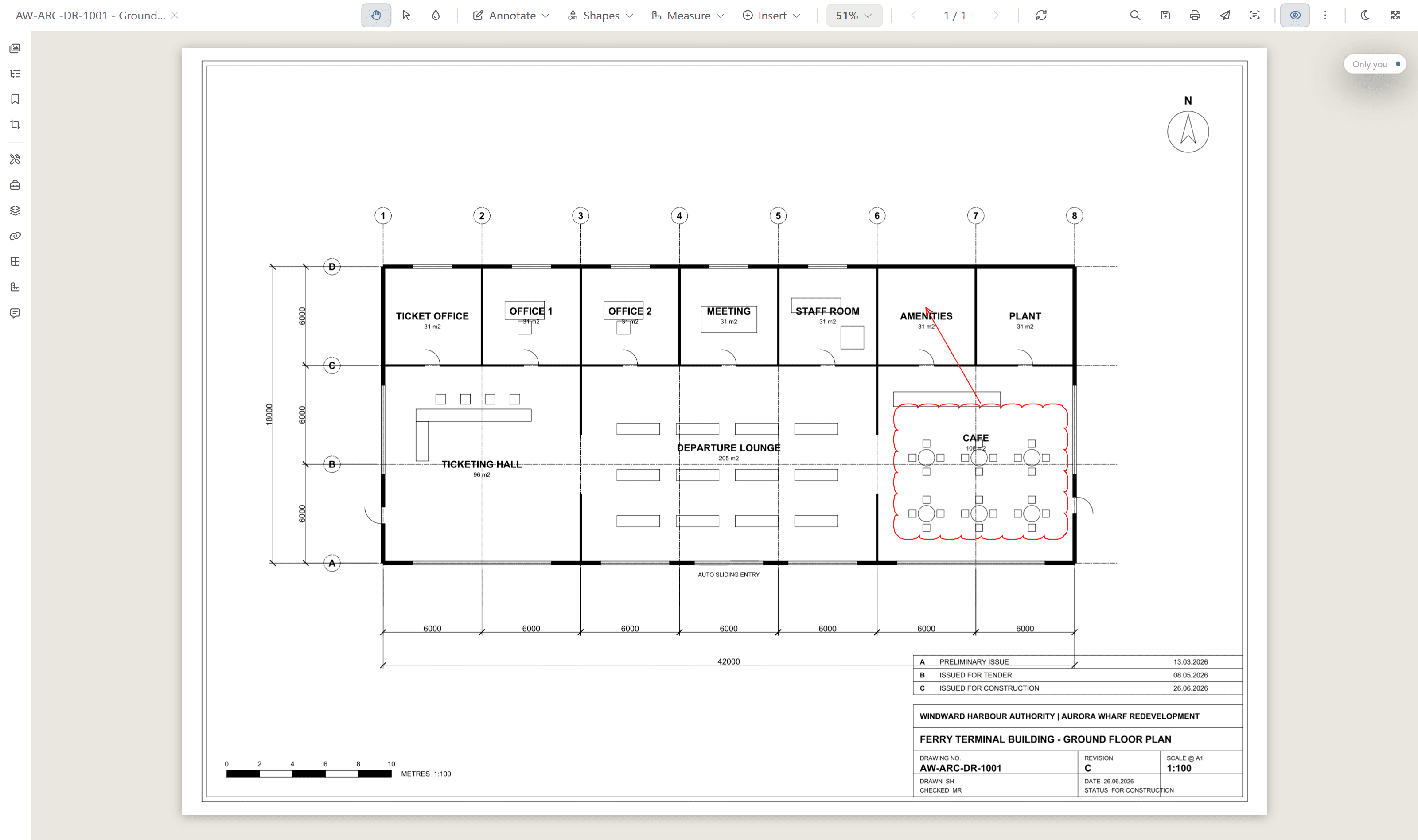
A record that outlasts the job it was delivered under.
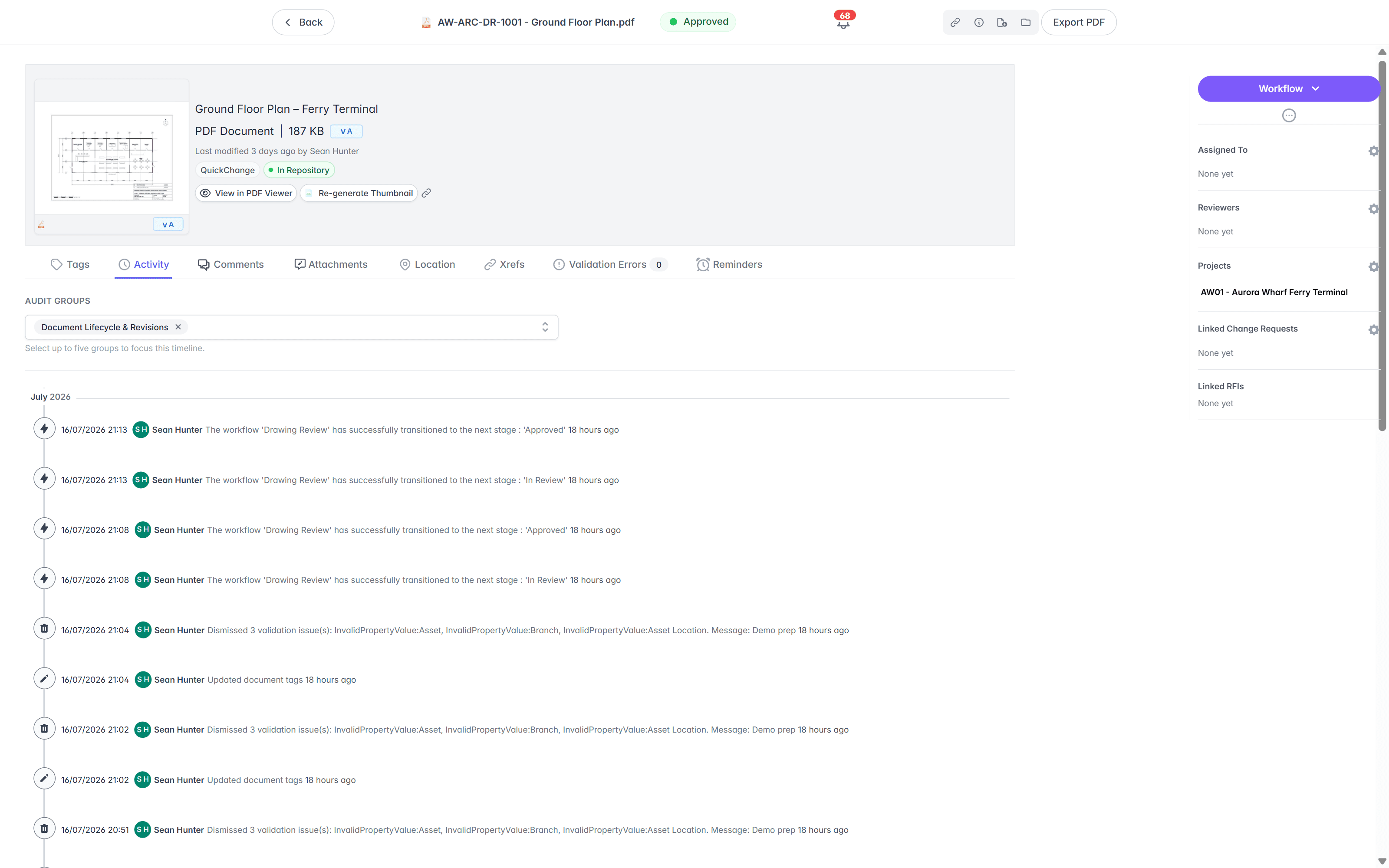
A job closes, a consultant’s contract ends, and the asset runs for another thirty years. Lunr holds the issued set as a controlled register from that day on, receives transmittals against a manifest, and keeps an audit trail behind every approval, revision, and metadata change. Hosting sits in Australia or the US, so data residency is a line item you can name in a tender.
- Hold the issued set as a controlled register that survives the job number, the consultant, and the contract.
- Receive tracked transmittals at handover, validated against a manifest so a missing as-constructed is caught on delivery.
- Keep a full audit trail behind every approval, revision, and metadata change, ready for a compliance review.
- Host the record in Australia or the US, in the region your procurement policy requires.
controlled register · transmittals · manifest validation · full audit trail · sovereign hosting
Search the words printed inside a scanned drawing.
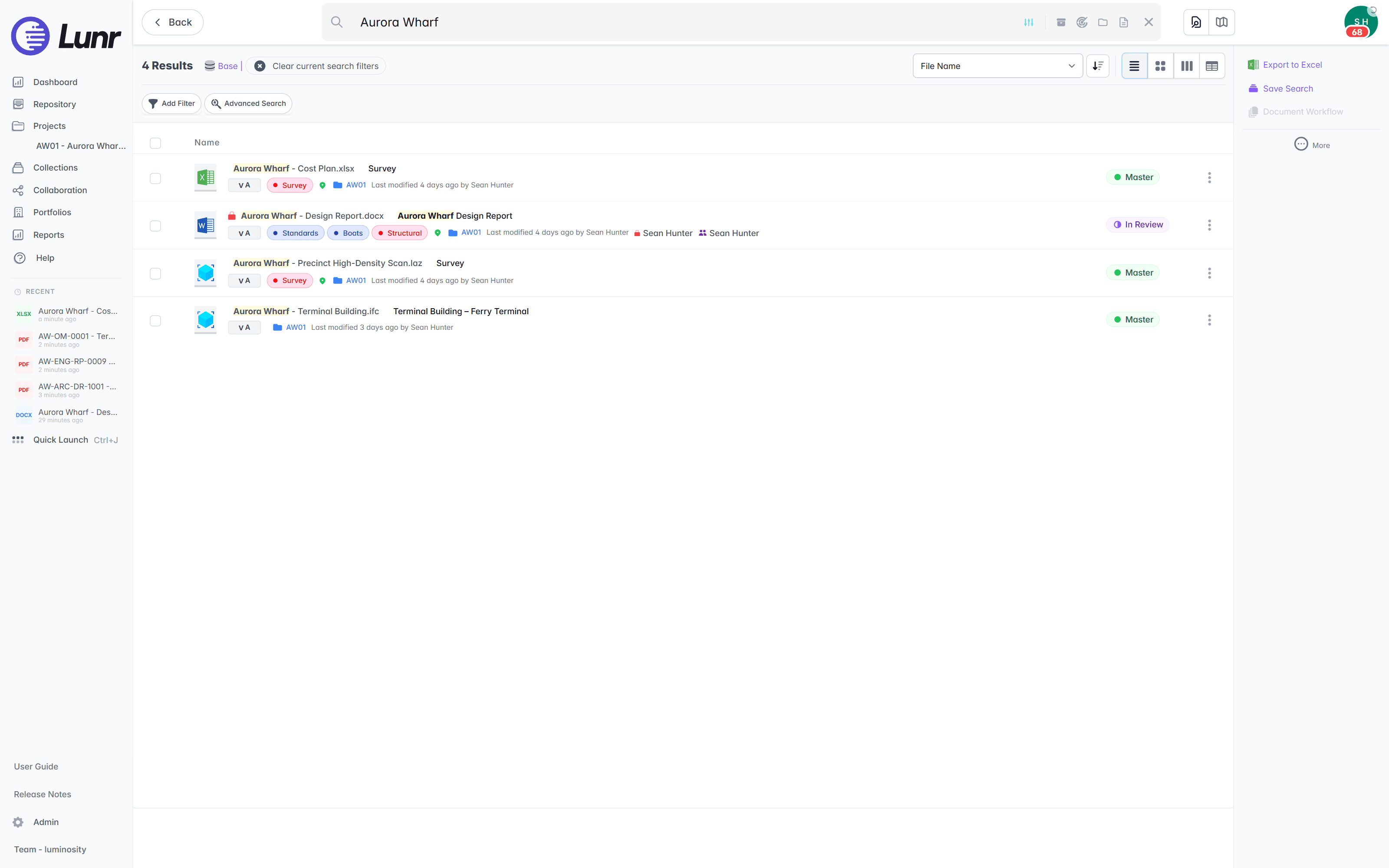
An owner inherits decades of scanned sheets that no attribute index can see into. XRAY runs OCR and AI full-text search across everything you store, so a valve tag from a 1994 scan turns up as fast as a file you saved this morning. For a dense drawing, Deep XRAY re-reads the sheet in high-resolution tiles, so faint or crowded text still resolves.
- OCR and AI full-text search across every DWG, DGN, RVT, PDF, and scanned image.
- Find a tag, a reference, or a note printed inside the drawing, not just the file name.
- Deep XRAY re-scans a dense sheet tile by tile, so nothing on the drawing is missed.
- Filter by tag and metadata, or find geo-tagged drawings on a map with polygon search.
OCR · AI full-text search · deep XRAY tile re-scan · tag and map filters
A register your own team configures.
Book a drawing in and Lunr numbers it, keeps its full revision history, and marks the previous revision as superseded. Title-block fields come across as searchable metadata, workflows and tags are set up by your document controllers, and every controlled document carries an audit trail behind it.
- A controlled register per set, showing the current revision and status of every sheet.
- Automatic document and version numbering, applied in your register format as drawings are booked in.
- Configurable review and approval workflows, with tag-based permissions your team sets.
- Superseded revisions kept and marked, never deleted and never mistaken for the current sheet.
controlled register · automatic numbering · configurable workflows · superseded marking
See document control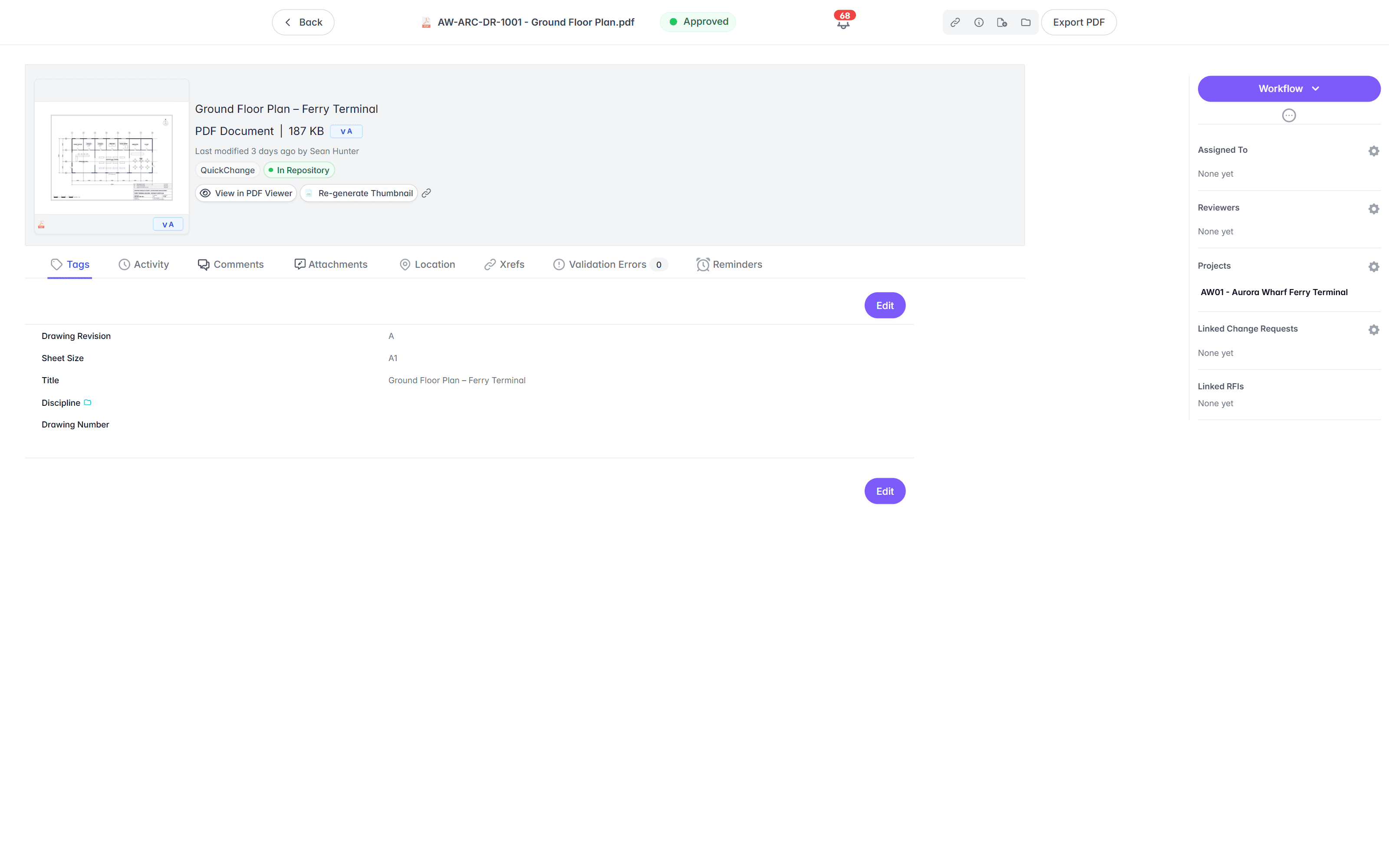
Move the owner’s record, leave the design office alone.
Nothing is ripped out on day one, and no live project is interrupted. Take the inventory, map the attributes, load and reconcile in batches, then cut over on your date. Your consultants keep 12d Synergy for the design data it manages well, and issue the controlled set to Lunr.
- 01Take the inventory
Read the jobs and folders you want to hold as the owner's record, and count what is there: documents, versions, renditions, and the attributes in use. Nothing moves before the inventory is agreed.
- 02Map attributes to tags
Each 12d Synergy attribute is matched to a Lunr tag, so drawing number, revision, and discipline stay searchable metadata. Unmatched columns are surfaced for you to resolve, and the mapping is saved and re-runnable.
- 03Load and reconcile
Documents come across in batches with their PDF renditions, then every record is reconciled against the inventory. Anything without a file or a tag is reported rather than dropped.
- 04Let the design office keep 12d Synergy
Your consultants and survey teams carry on with managed datasets, CAD plugins, and their File Replication Servers through delivery, and issue the controlled set to Lunr. Nothing forces an all-or-nothing move.
Export all metadata, drawings, and models at any time, so the record is never locked to us. See the CAD, GIS, and facilities connectors that bring drawings and models in on the connectors page.
Australian owners already run their record on Lunr.
Universities, utilities, energy companies, and government departments run their drawing record on Lunr, from project delivery through the operating life of the asset, on their own team.
documents under management on Lunr. Proof the drawing record holds up at owner-and-portfolio scale.
“Lunr is a simple solution that provides the flexibility to develop the system to our needs. Lunr is simple to use, and minimal training is required.”
Questions owners ask about Lunr and 12d Synergy.
What 12d Synergy is built for, what an owner carries to keep it running across a whole organisation, and what it takes to move the record into the browser without interrupting the design office.
- Is Lunr a 12d Synergy alternative?
- For an asset owner, yes. 12d Synergy is Australian AEC data management built around the design office, with managed datasets for 12d Model and other folder-based engineering data, CAD plugins at the desk, and a Windows client as the main application. Lunr is the owner's controlled record, held in the browser, with revision control, transmittals, and OCR search inside scanned sheets, and no client to deploy. Owners choose Lunr when the record has to stay reachable by everyone in the organisation for the decades after the job closes.
- What is the difference between Lunr and 12d Synergy?
- The difference is who the record is shaped for. 12d Synergy is shaped for the firms producing the data: jobs, folders, tasks, managed datasets, and byte-level replication between offices, reached through a Windows client. Lunr is shaped for the owner receiving it: a controlled register, revision history, transmittals, and full-text search across scans, reached through a browser on any operating system. 12d Synergy holds the advantage while the civil design is being made. Lunr holds it once the asset is built and has to be operated.
- Do we still need a Windows client, Windows Server, and SQL Server?
- No. Lunr runs as a hosted service, so there is no application server, no SQL Server instance, and no desktop client between a person and a drawing. There is no .NET prerequisite to push to workstations and no memory sizing to redo as your user count grows. Drawings, models, and Office files open in the browser on macOS, Windows, a tablet, or a phone, which matters most for the operations, facilities, and contractor users an owner never wanted to deploy software to.
- What happens to our 12d Model, Civil 3D, and survey data?
- It stays where it works best. 12d Synergy manages folder-based 12d Model projects, survey datasets, and CAD dependencies well, and a design office should keep it for that. Lunr takes the issued output: the drawings, models, reports, and as-constructed records that become the owner's controlled set. They arrive by connector, bulk import, or a transmittal from the consultant, and nothing is converted away from its native format.
- Do people need a particular licence tier to view or mark up a drawing?
- No. Every capability is standard: the viewers, revision control, project spaces, XRAY search, sovereign hosting, single sign-on, and the full audit trail. There is no Collaborator Pro, Information Management, or Advanced Data Management distinction to administer, so a facilities officer who needs to measure a sheet and a document controller who runs the register work in the same system without a licence change. Pricing is shaped to your organisation, so send an RFQ or an RFP and we will scope it with your team.
- Both products are Australian. Where is the data actually hosted?
- Lunr is built in Melbourne by Lunr Labs and hosted in Australia or the US, in the region your procurement policy requires, so data residency is a line item you can name in a tender rather than a question you carry. 12d Synergy publishes three deployment choices of its own: cloud hosted by 12d Synergy, self-hosted on your server, or deployed on your own cloud infrastructure. Ask both vendors to state the hosting region, the sovereignty terms, and the exit terms in writing, and read the answers side by side.
- How does moving off 12d Synergy work, and what comes across?
- Revisions, renditions, dates, and attributes come across as controlled records. Revision numbers land as controlled metadata, so REV C stays REV C, and the native drawing and its PDF rendition stay together as one record. Each 12d Synergy attribute is mapped to a Lunr tag, unmatched columns are flagged for you to resolve, and every batch is reconciled against the inventory before it is booked in. Your design office keeps working in 12d Synergy throughout, so the owner's record moves without touching a live project.
Let the design office keep 12d Synergy. Give the owner the record.
Book a walkthrough with someone who knows what a transmittal and an as-constructed drawing are, and watch Lunr run against a set of your own.
10M+ documents under management · Hosted in Australia and the US · SAML · Full audit trail · Export anytime
- entity
- Lunr Labs Pty Ltd
- location
- Melbourne AU
- workspace
- documents.lunr.app
- rev
- 2026