The engineering record for the public assets a council holds.
Councils, state agencies, and government asset owners keep drawings for roads, water, buildings, and parks for decades, through staff turnover and outsourced engineering. Lunr holds that record under revision control, keeps it searchable back through the scanned archive, and makes contractor handover arrive complete, so the record stays with the public owner.
10M+ documents under management · Hosted in Australia and the US · SAML · Full audit trail · Export anytime
One record that outlasts staff turnover and consultants.
Public assets outlive the people and firms who document them. Keep every drawing under revision control, so the superseded copy is never mistaken for the current one, and keep a full audit log behind every change, ready for a records request years later.
- Hold decades of drawings for roads, water, buildings, and parks under revision control.
- Automatic document and version numbering, applied in your register format as records are booked in.
- A full revision history on every drawing, so any change can be traced and evidenced.
- Export all metadata, drawings, and models at any time, so the public record stays with the owner.
revision control · automatic numbering · audit log · records custody · export anytime
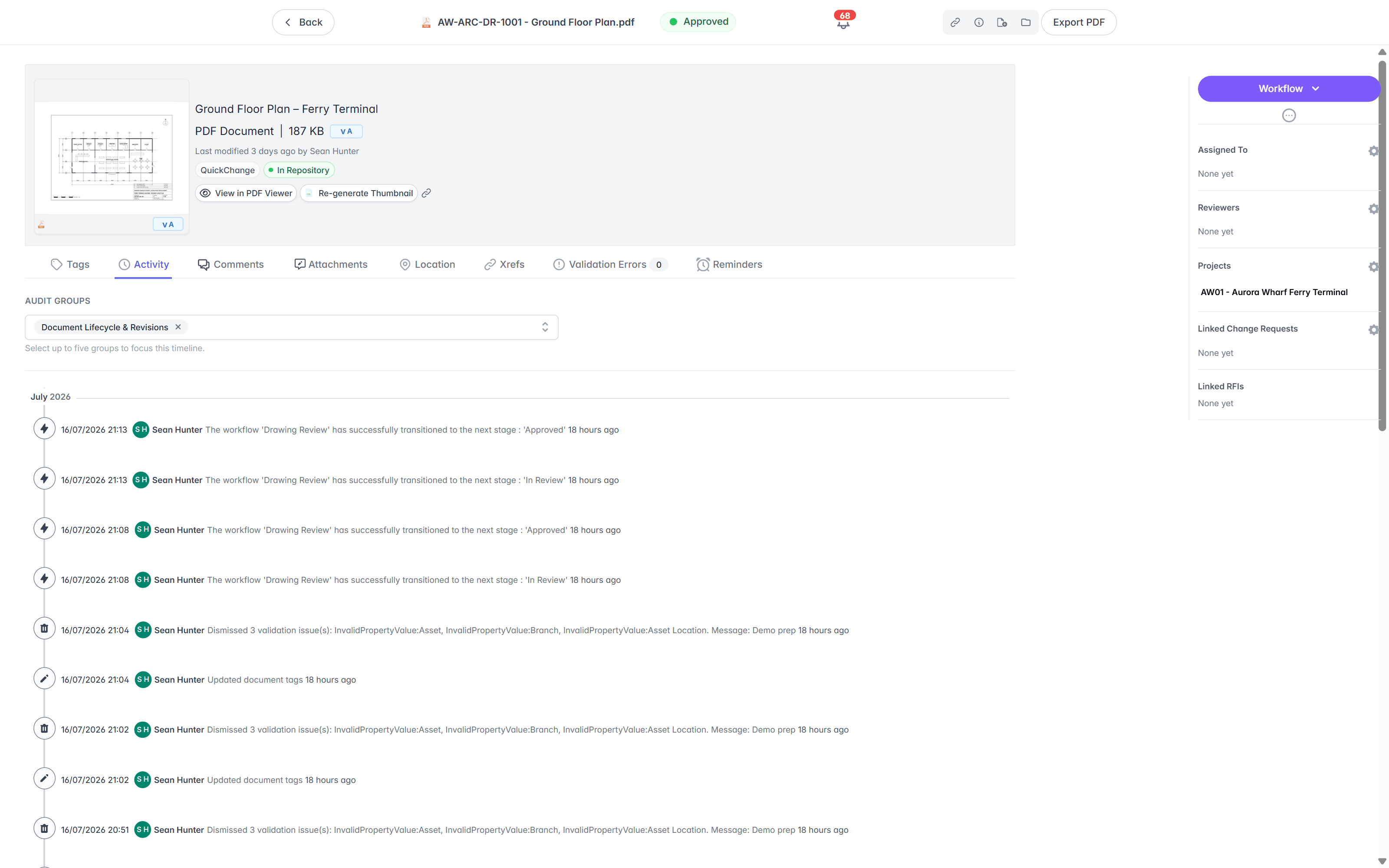
As-constructed sets that arrive complete.
When engineering is outsourced, the record only stays whole if handover is checked on the way in. Validate each package against a manifest, so a missing as-constructed drawing is caught on upload, not discovered on the next project.
- Validate each handover package against a manifest, and read title-block tags into metadata.
- Issue tracked transmittals, and run change requests that hold, forward, and close.
- Move deliverables through configurable review and approval workflows.
- Contractors and consultants deliver as Collaborators, and see only what you grant them.
manifest validation · transmittals · change requests · configurable workflows · Collaborators
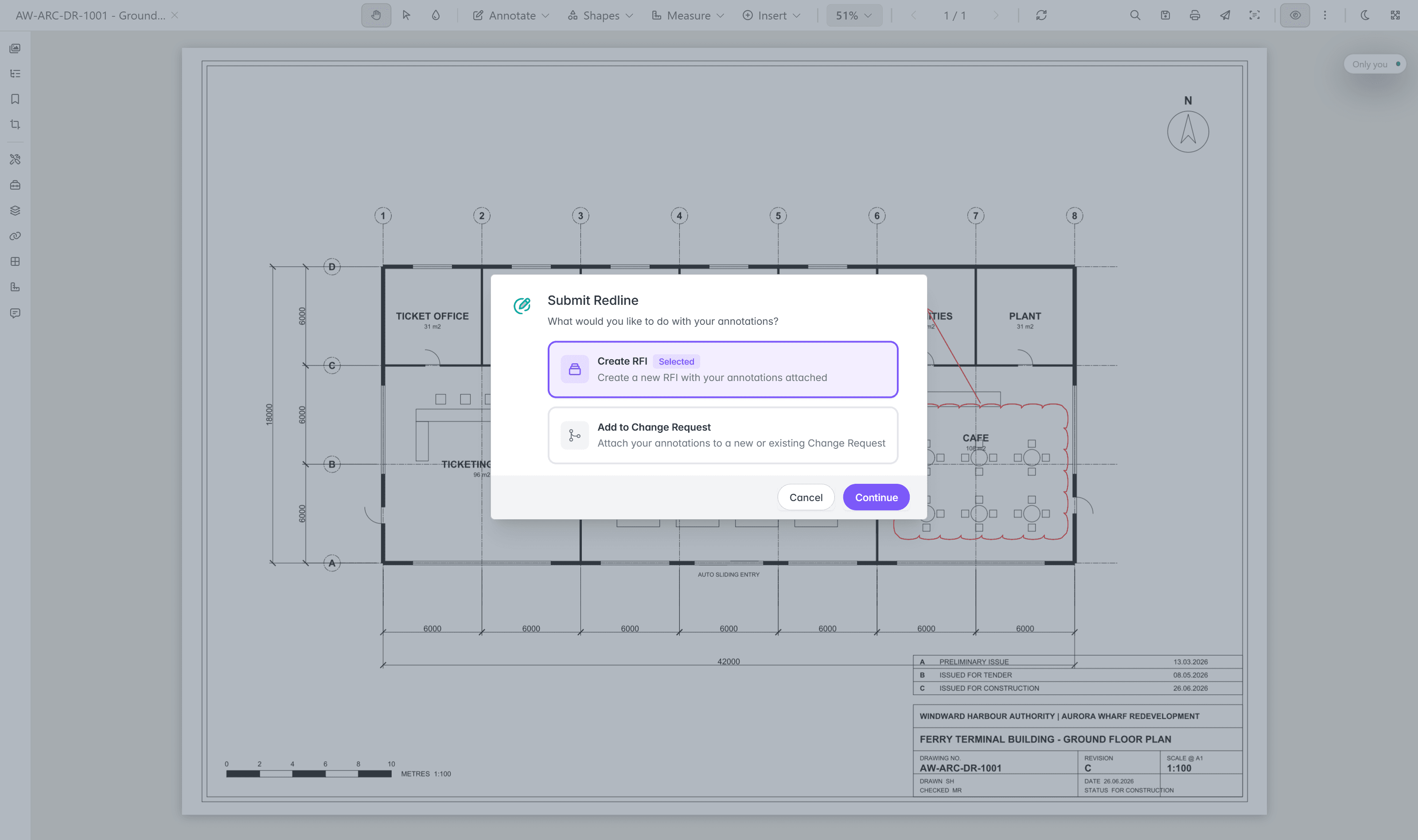
Staff see the drawing without a CAD licence.
Most of the people who need a council drawing do not run CAD. The Rift viewer renders DWG, DGN, and PDF at full fidelity in the browser, with layers, measurement, and markup, so asset, facilities, and records staff review a drawing without a seat. Models open in Foundry, point clouds in Nimbus.
- View DWG, DGN, RVT, and PDF in the browser, with no CAD licence and nothing to install.
- Toggle layers, measure, and mark up the drawing straight in the viewer.
- Open BIM models in Foundry and point clouds in Nimbus from the same record.
- Turn a redline into a change request or an RFI without leaving the viewer.
browser viewers · layers · measurement · markup · no CAD licence
Try the viewers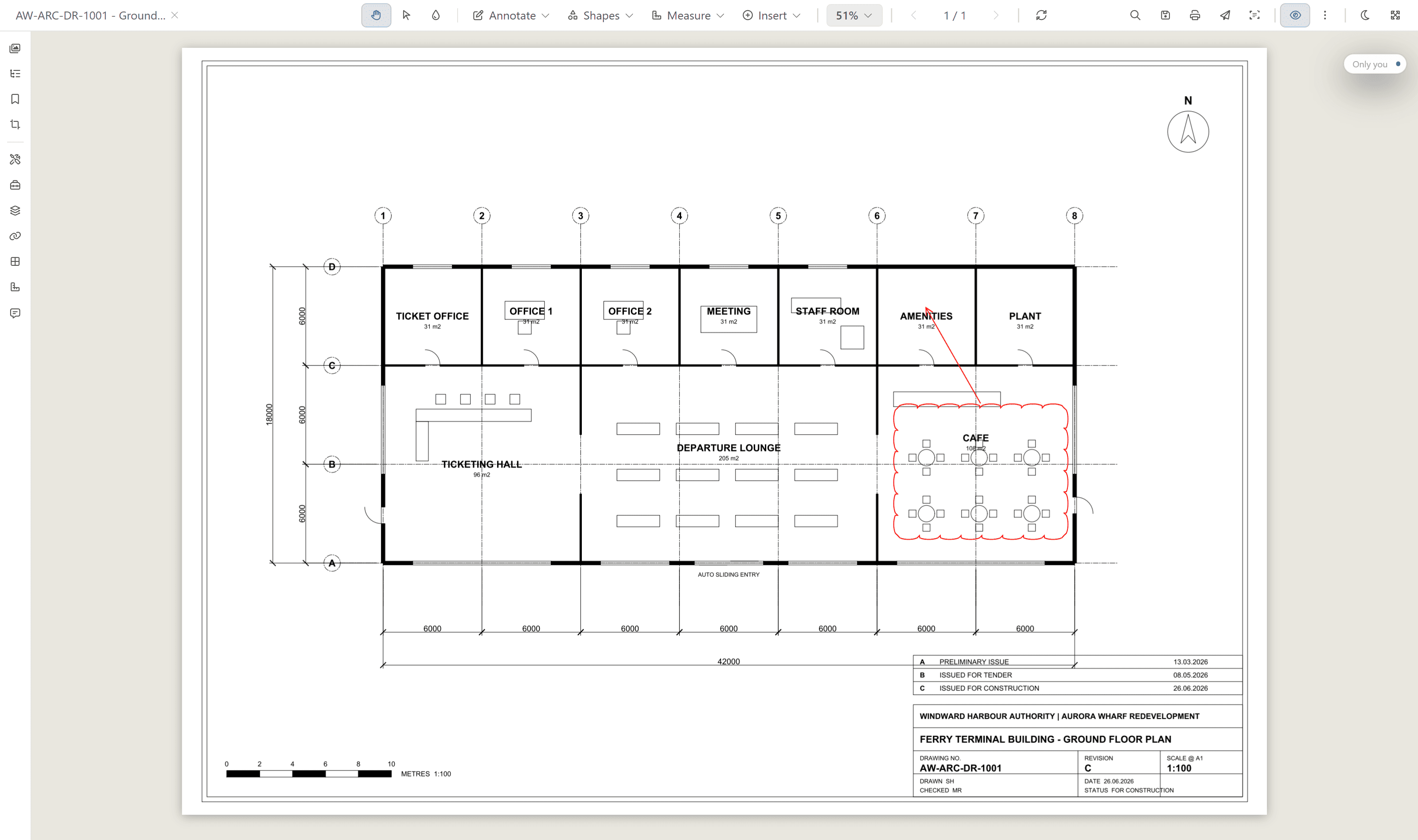
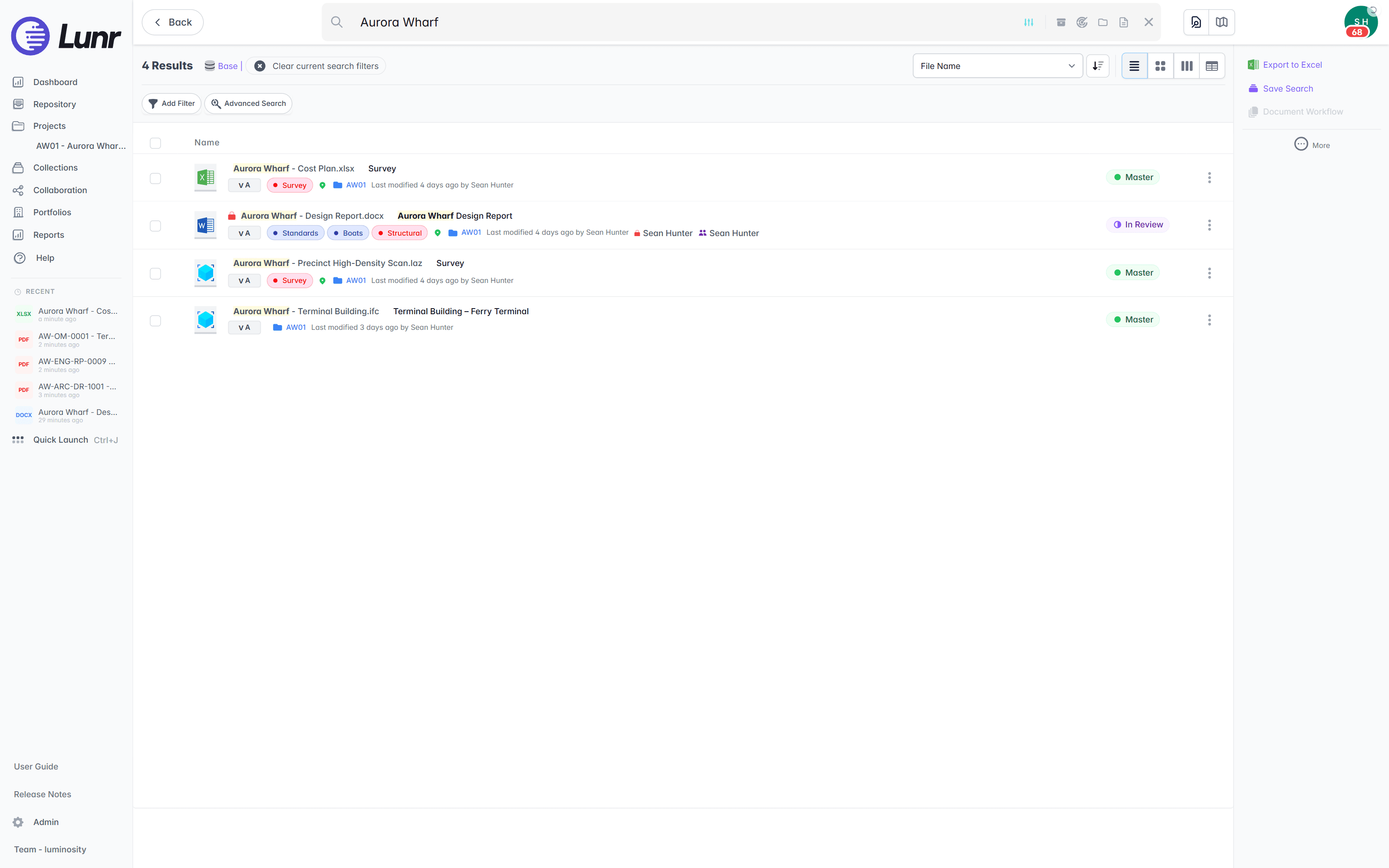
Search the plans, back through decades of scans.
A council archive runs back to plans drawn long before CAD. XRAY runs OCR and full-text search across every drawing, scans included, so a lot number, a valve tag, or a note is findable whether the sheet was saved this morning or scanned from a 1980s archive.
- OCR and AI full-text search across every DWG, DGN, RVT, PDF, and scanned image.
- Find a tag, a lot number, or a note printed inside the plan, not just the file name.
- Deep XRAY re-scans a dense sheet tile by tile, so nothing on the drawing is missed.
- Filter results by metadata, tags, and revision to narrow a large archive fast.
OCR · AI full-text search · deep XRAY tile re-scan · metadata and tag filters
Open the drawing from the map you already use.
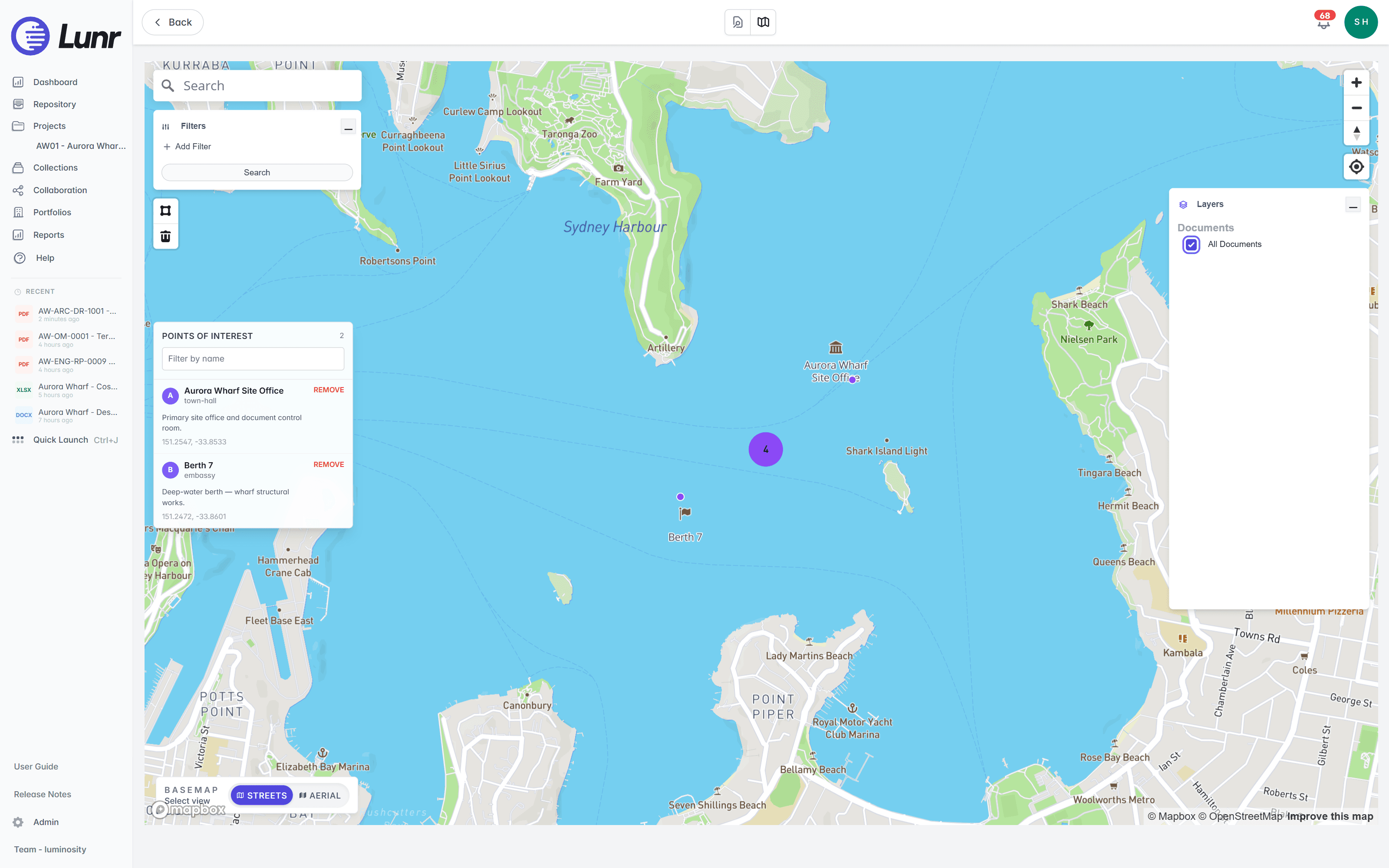
For network assets, GIS is where staff already look. The Esri and ArcGIS connector ties each drawing to its place on the network, so the engineering record opens straight from the map you run for roads, water, and reserves.
- Tie drawings to their place on the network through the Esri and ArcGIS connector.
- See every geo-tagged document on a live map, clustered by location.
- Draw a boundary around a suburb, a reserve, or a plant, and Lunr returns every document inside it.
- Browse the record from where you stand in the field.
Esri and ArcGIS · geo-tagged documents · polygon search · field access
Built to clear a government tender.
The answers a tender panel and a CISO look for are already in place. Pricing is shaped to your organisation, with every capability included as standard.
Data centres in Australia and the US. Your instance sits in the region you require, so records stay onshore.
Staff sign in with your identity provider. Contractors and consultants join as Collaborators.
Every controlled document carries a full revision history and audit log, ready for a public records request.
Export all metadata, drawings, and models at any time. The public record stays yours.
Every capability is standard, with pricing shaped to your organisation. Evaluation is fast, not a discovery project.
An accessibility statement is published and maintained for the browser workspace.
Read the accessibility statement, or connect the GIS, facilities, and CAD systems your council already runs on the connectors page.
Trusted with records the public keeps for decades.
A public-sector estate close to home runs its drawing record on Lunr. The University of Canberra moved its archive off SharePoint and put it under control.
“Lunr is a simple solution that provides the flexibility to develop the system to our needs. Lunr is simple to use, and minimal training is required.”
10M+ documents under management on Lunr today.
Read the University of Canberra case studyQuestions councils ask about drawing management.
How the record is held today, where the data sits, and what it takes to hand the archive over and keep it.
- How do councils manage engineering drawings today, and how is Lunr different?
- Most councils keep drawings in nested folders on SharePoint or a shared drive, split across teams and outsourced consultants. The current revision is a guess, superseded sheets stay in circulation, the text inside a scanned plan is invisible to search, and there is no audit trail. Lunr puts every drawing under revision control in one register, keeps the superseded copy marked, searches the words printed inside each sheet, and logs every change. The University of Canberra moved more than 20,000 documents off SharePoint onto Lunr for this reason.
- Where is our data hosted, and does it stay onshore?
- Lunr is hosted in Australia and the US, and your instance sits in the region you require, so records stay onshore for data sovereignty. Staff sign in over SAML with your identity provider, external parties join as Collaborators, and every controlled document carries a full audit trail. Over 10 million documents are under management on Lunr today.
- How does Lunr handle contractor handover and as-constructed sets?
- Validate each handover package against a manifest, so a missing as-constructed drawing is caught on upload rather than years later. Lunr reads title-block tags from every sheet into metadata, applies your register numbering as records come in, and issues tracked transmittals. The delivered set arrives complete and lands in the register the moment the contractor hands it over.
- Can staff without a CAD licence view drawings?
- Yes. Anyone with access opens DWG, DGN, and PDF drawings in the browser through the Rift viewer, with layers, measurement, and markup, and nothing to install. Models open in Foundry and point clouds in Nimbus. A CAD seat is only needed to author drawings, so asset, facilities, and records staff can see the drawing without one.
- Can Lunr search our scanned drawing archive?
- Yes. XRAY runs OCR and full-text search across every drawing, scans included, so a valve tag, a lot number, or a note printed on a plan is findable whether the sheet was saved this morning or scanned from a 1980s archive. Deep XRAY re-scans a dense sheet tile by tile, so nothing on the drawing is missed.
- Does Lunr work with our GIS?
- Yes. The Esri and ArcGIS connector ties each drawing to its place on the network, so staff open the engineering record straight from the map they already use for roads, water, and reserves. Geo-tag documents, plot them on a live map, and draw a boundary around an area to return every document inside it.
- If we change systems later, can we take our records with us?
- Yes. Export all metadata, drawings, and models at any time, in bulk, so the public record is never locked in. The custody of the record stays with the owner, not the vendor, which is the point of holding it under control in the first place.
See it on your own council drawings.
Book a walkthrough with someone who knows what a transmittal and an as-constructed set are, and we will map Lunr to your asset record.
10M+ documents under management · Hosted in Australia and the US · SAML · Full audit trail · Export anytime
- entity
- Lunr Labs Pty Ltd
- location
- Melbourne AU
- workspace
- documents.lunr.app
- rev
- 2026